Dext bundles are far cheaper than buying direct, but most firms never decide who benefits. Pick a model, fill your slots and stop the leaks.

Alex Millar
Co-founder & CEO
In this article
guides

Playbook when you buy Dext in bulk

Dext sells bundles to accounting firms at a price well below what a client pays direct. A client buying Dext on its own pays $42 a month ex GST in Australia. One firm on a 65 client pack paid $1,200 a month, about $18.46 a client. Depending on volume, firms often get 50% off retail, and sometimes more. What most firms don't have is a process for what happens next. Which clients go on the bundle? Who pays? Who notices when the slots stop being used?

Why are you buying Dext in bulk?

Most firms buy Dext because it makes their own bookkeeping faster. The clients don't need to know. They never see a Dext invoice, and the firm absorbs the cost as part of running the practice. This is the most common reason, and a good one.

Some firms use the bundle as an incentive. A client who already pays Dext direct can move onto the firm's account for about half the price, whatever the volume. The client saves money, the firm gets another client on a tool it already uses, and the bundle fills up.

A few firms resell Dext at the retail price and keep the difference. It works, but most firms are hesitant to on-charge Dext at all.

Any of these is fine. Not deciding is the problem, because the slots still get used and somebody still pays for them.

How does Dext bulk pricing work?

A bulk Dext plan has a few parts. The practice plan covers a set number of clients, or an unlimited number on Enterprise. Add-ons sit on top: Data Health is sold in blocks of five clients, and line item, supplier statement and bank statement extraction are sold as bundles of documents or sheets. Go over a bundle and Dext bills overage per item.

You pay for the plan whether or not every slot is in use. That is why Dext discounts bundles so heavily: it wants firms to buy more than they need. The discount is permanent, and plans are billed either monthly or annual paid monthly, with better pricing on annual.

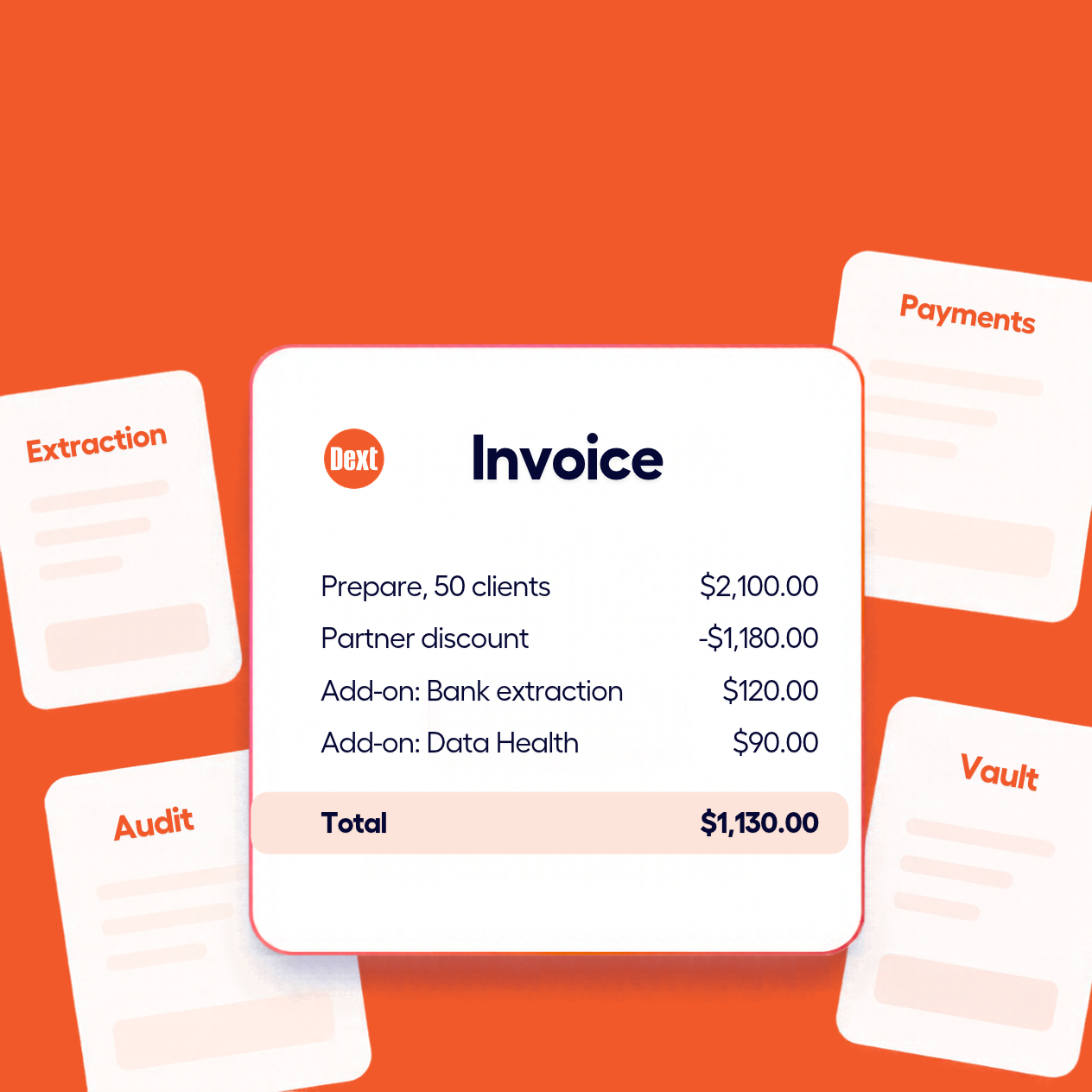
Discounts show up as separate negative lines under each item on your invoice, and they differ from firm to firm. One firm we have seen gets 40% off the platform and 100% off the add-ons. Another has no discount lines at all. Check your own invoice before you pick a model, because what you pay per client decides how much room you have.

Where does the bulk discount leak?

Money leaks out of a Dext bundle in four places:

  1. Slots nobody uses. The firm buys a pack bigger than it needs and pays for the empty slots every month. On a 65 client pack at $1,200 a month, 45 clients means $26.67 a client, not $18.46.
  2. Bundles bigger than the usage. One firm paid for a 500 document Line Item bundle and used 76 documents. It paid for 50 supplier statements and used 11. It pays for Data Health blocks covering 100 clients, with the module on for 8.
  3. Overage that never gets discounted. On one invoice every Data Health block was discounted to $0, and the supplier statement overage was still billed at the full $0.70 each. Small amounts, but they repeat every month.
  4. The client leaves and the slot stays. Dext keeps billing the plan until someone removes the client or shrinks the pack, and nobody notices until someone reads the invoice line by line. In one usage export, 10 of 34 clients had no activity in the month. Some of them may have left or never started.
Thank you! Your submission has been received!
Oops! Something went wrong while submitting the form.
T’s & C’s apply

Are you losing money on disbursements?

Request a free audit to determine how much money you may be losing by undercharging your clients on Xero, QuickBook and more.

Which model should you pick, and how do you automate it?

‍

Decide what model suits your firm

There are three models, and your reason for buying in bulk decides which one. Pick one per client, or set a default and handle the exceptions.

  1. Absorb the cost. The client pays nothing and may never know you use Dext. It is a cost of running the practice, like any other tool. This is the most common model, and the right one if Dext mostly speeds up your own bookkeeping.
  2. Move clients over at half price. A client who pays Dext direct moves onto your account and pays about half what they pay now. It suits a larger business that gets real benefit from Dext. The client pays less than direct, and you recover most of your cost.
  3. Resell at the retail price. The client pays what they would pay Dext direct and the firm keeps the difference. Maximum margin, but many firms won't on-charge Dext.

Here is what the last two models are worth on a 65 client pack costing $1,200 a month, with every slot in use.

Move clients at half priceResell at retail
Client is billed each month$21$42
Firm pays Dext each month, per client$18.46$18.46
Firm keeps each month, 65 clients$165$1,530
Firm keeps over 12 months$1,980$18,360
SuitsMove direct clients onto your accountRevenue stream

‍

At $21 a client, you need 58 of your 65 slots filled just to cover the bill. Fill 45 and you lose $255 a month. Retail is $42 on the monthly plan and Dext says annual is up to 20% cheaper, so check what your client pays today.

Set it up in Rechargly

Set the monthly price for Dext once. Rechargly then bills every client on your Dext account that amount each month, so nobody edits a repeating invoice.

Set exceptions for clients you want to treat differently

If a client should pay a different amount, or nothing, set an exception for them. The default applies to everyone else.

Leave add-ons out

Add-ons are the hard part to recharge. Somebody has to go through the invoice and adjust it line by line, and most firms use Data Health and extraction for their own bookkeeping anyway. We suggest treating them as a cost of running the practice. Use the monthly usage export in Dext to check you are not buying more than you use.

FAQ

How much cheaper is a bulk bundle than Dext direct?

Dext lists its business plan at $42 a month ex GST in Australia, for 250 documents and 5 users. A firm on a 65 client pack paid $1,200 a month, about $18.46 a client. Discounts differ between firms, so check your invoice.

Do my clients need to know I use Dext?

No. You can use Dext across your clients to streamline your bookkeeping and never on-charge it.

Who keeps the discount, the firm or the client?

You decide. Most firms keep it as a cost saving. Some pass it on to move a direct client onto their account, and a few resell at retail.

Do I pay for slots I don't use?

Yes. Dext bills the plan whether or not every slot is in use, so check the usage export for clients with no activity.

Is the discount permanent?

Yes. Unlike a promo, the bulk discount does not expire, so there is no end date to track. Some firms are billed monthly and some annual paid monthly, and annual terms usually come with better discounts.

Can I treat some clients differently?

Yes. Set a default model for the firm, then set an exception for any client who should pay a different amount.

How do I stop paying for clients who have left?

Dext keeps billing your plan until the client is removed or the pack is reduced, where your contract allows it. Check the usage export each month and remove clients who have gone.

Alex Millar
Co-founder & CEO

Similar articles

Get a personalised product tour

Book a product demo